Chaperonage and propriety rules for unmarried women
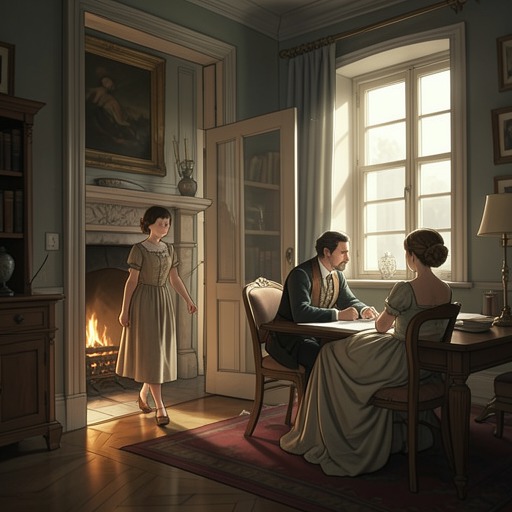
Just DesertsChaperonage and propriety rules for unmarried women are a central social mechanism in Elizabeth Bennet’s life. They prohibit a young gentlewoman from being alone with an unrelated man or corresponding with him directly, yet they do not eliminate her relationships or ambitions. Instead, the rules force her meetings with Sir David Pentland into carefully staged forms: chaperones, carriages, letters routed through trusted women, and public respectability become the visible structure through which private education and mutual confidence can proceed.
Definition and Social Operation
The rule treats a woman’s unsupervised presence and unsupervised correspondence as threats to propriety, regardless of the actual character of the people involved. Elizabeth therefore cannot simply meet Sir David alone, nor can she write to him openly. The restriction is not merely personal etiquette; it organizes access, movement, information, and reputation. A meeting requires a respectable intermediary, while a letter must appear to concern an acceptable subject and pass through an acceptable channel.
The same system also determines Elizabeth’s ordinary mobility. Her visits to Grenadine Reef occur only during a small portion of her week, while the rest of her life resembles that of her sisters: she visits friends and neighbours, shops in Meryton, conducts tenant visits with Jane Bennet and Mary Bennet, plays the piano, attempts embroidery, and sits with Thomas Bennet in his book room. Because her absences are limited and embedded in familiar routines, she can visit a widower at his estate twice a week without her parents discovering the arrangement. Propriety thus operates through the appearance of regularity as much as through actual supervision.
Chaperones and the Harkness Arrangement
The practical loophole in the rule is supplied by Vivian Harkness and Violet Harkness, two long-term workers at the dower house. Vivian had accompanied Violet when Violet needed to escape her employer five years earlier; rather than return to service, the sisters remained under Mrs. Perkins and helped run the household. Their history gives them both practical competence and a trusted position within the refuge’s domestic structure.
One of the sisters waits for Elizabeth with a phaeton and acts as her chaperone when she meets Sir David. The arrangement makes the journey formally defensible while also providing real protection. When Elizabeth later considers leaving Longbourn after reaching legal adulthood, Sir David rejects the idea that she should travel alone by post-stage. He instructs her to walk as usual to the border of the estates, where one of the Harkness sisters will meet her with the phaeton. She is then to transfer into his coach and travel directly to Edward Gardiner’s house accompanied by both sisters, a coachman, and two footmen. The same framework that restricts Elizabeth’s independent movement is therefore turned toward her physical safety.
Correspondence Through Respectable Intermediaries
The rules against direct correspondence are handled through a deliberately thin but effective fiction. Elizabeth writes to Vivian Harkness about the questions she intends to ask Sir David on her next visit. Vivian repeats those questions to Sir David, who discusses his answers and his own questions with Vivian or Violet. The sisters then write the material out and send it to Elizabeth. What appears to be correspondence between women becomes an indirect exchange between Elizabeth and Sir David without formally violating the expected boundaries.
This method is described as a wafer-thin veneer of respectability, but its weakness is also its ingenuity. The rules demand the performance of propriety rather than transparent proof of emotional distance, and the Harkness sisters provide that performance. They are not passive witnesses. They transmit questions, preserve answers, maintain continuity when bad weather prevents travel, and create an information network that enables Elizabeth’s education. Female intermediaries make possible a conversation that the social code would otherwise obstruct.
Education, Estate Management, and Female Agency
Chaperonage does not prevent Elizabeth from learning; it shapes the circumstances in which she learns. Lady Radha Pentland gradually fills the role of a grandparent for Elizabeth, whose grandparents are all dead and whose memories of her paternal grandmother end with her death when Elizabeth was five. Through conversation and shared experience rather than formal lessons, Lady Radha trains Elizabeth in the practices expected of a woman managing an estate.
The instruction extends beyond household matters. Elizabeth observes that Lady Radha does not merely set menus but acts as a helpmate to David Pentland across every aspect of the estate. During visits that sometimes include both Pentlands and their steward, Mr. Case, Elizabeth sees domestic management joined to broader responsibility. She also witnesses a marriage in which companionship remains vivid after more than thirty years. The Pentlands enjoy one another’s company and share their daily life, giving Elizabeth an example of marriage as a relationship between partners rather than an exchange of material advantages.
Through Sir David, Elizabeth’s education reaches business and investment. Her favourite word becomes “why?”; she asks why he is invested in particular businesses or industries, and he explains assumptions that he had taken for granted for decades. Unlike an instructor who merely expects obedience, he encourages her to make suggestions. Many are rejected because she lacks information, while others fail because of opposing parties or the condition of the war. Yet between a fifth and a quarter of her original suggestions are seriously considered, and many are implemented. The supervised relationship therefore produces intellectual authority: Elizabeth is protected by propriety while being treated as capable of judgment.
Public Charity and Institutional Contradictions
The propriety system also frames Elizabeth’s entry into public charitable work. The Asylum for Female Orphans lies south of the River Thames, and Elizabeth first reaches it with her aunt by crossing at Blackfriars Bridge and continuing toward St. George’s Fields. The institution houses about 200 girls between nine and fourteen years old, cleans and feeds newly admitted children who may have gone without either for days, and prepares them for employment, chiefly domestic service.
Elizabeth notices the contradiction in an institution for girls being governed by a committee of 19 gentlemen. The Asylum has royal patronage, with Queen Charlotte as Patron and one of her sons as President, while the elected Governors are all men and normally meet on Thursdays. Her work there places female experience, education, and employment within a structure formally controlled by men. Yet volunteer women work directly with the staff and give the girls opportunities to practise the skills they hope will secure employment. Elizabeth’s participation shows her learning to move through institutions without accepting their male governance as the only form of useful action.
Lady Maitland’s presence further complicates the boundary between propriety and initiative. Although she is old enough to be Elizabeth’s mother and is in fact two years older than that, the two women establish an easy intellectual connection. Because Elizabeth has heard Lady Radha’s accounts of India before her capture, she can ask informed questions about Ceylon. Lady Maitland consequently judges her a young woman of substance and considers trying her hand at matchmaking. Supervised female sociability becomes a route to recognition, employment, charity, and possible marriage rather than a mere restraint.
Consequences and Narrative Significance
The rule’s consequences are double-edged. It exposes Elizabeth to surveillance and requires her to disguise the scale of her education and relationships, especially from her own family. At the same time, it encourages the creation of a female-led network involving Vivian Harkness, Violet Harkness, Lady Radha, Lady Maitland, Mrs. Perkins, and Elizabeth’s aunt. Respectability becomes not only a limitation but also a resource that can protect women, carry information, and support movement across households and estates.
The later proposal that Edward and Madeline Gardiner move permanently to Grenadine Reef makes the security problem explicit. Their presence would give the estate an ordinary family household and help counter speculation that Elizabeth had inherited it. It would also reduce slanders against Elizabeth, protect her from fortune-hunters, and keep her from becoming a prisoner in her own home, afraid that any unaccompanied interaction might create a compromise. The proposal demonstrates that propriety rules shape the architecture of estates and families as well as individual conduct.
The narrative therefore presents chaperonage as a system of social power whose enforcement is uneven but whose effects are tangible. It can conceal, restrict, and threaten a woman’s reputation; it can also be redirected into escort, refuge, education, and collective protection. Elizabeth’s experience does not abolish the rule. It reveals how women and their allies learn to operate within its visible forms, turning the demand for propriety into a carefully controlled instrument of independence.